1/2" (15 NB) to 48" (1200 NB) · 150# to 2500# · FF / RF / RTJ
Flanges
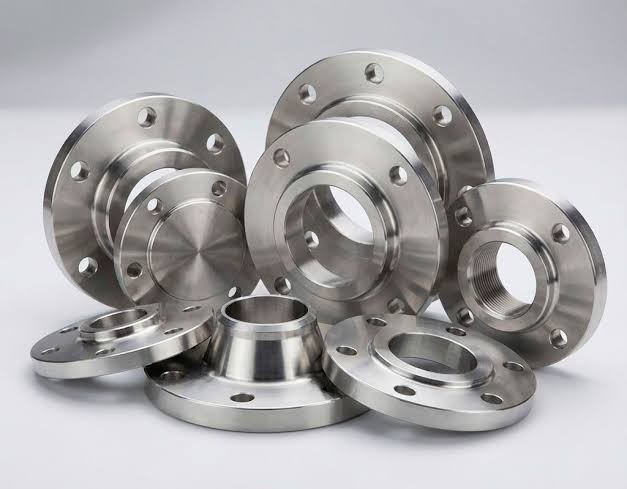
Industrial flanges for high-pressure and high-temperature service, in standard and custom-engineered designs.
Our industrial flanges are ideal for high-pressure and high-temperature applications across various industries. Carefully engineered for seamless installation, these flanges ensure reliable performance. Along with standard options, we also offer custom-designed solutions tailored to meet our customers' specific needs.
Available Grades
ASTM A182 F304 / F316F44 / F51 / F53 / F55 / F60 / F61ASTM A105 / A350 LF2F5 / F9 / F11 / F22 / F91Monel 400 / 500Inconel 600 / 625 / 825Cu-Ni 90/10 & 70/30
Call sales: +9199208 77660
Key Features
- Weld neck, long weld neck, slip-on, blind, SORF, RTJ, lap joint and orifice types
- Flat Face (FF), Raised Face (RF) and Ring Type Joint (RTJ) facings
- ANSI, ASME, BS, API, JIS and custom drawing dimensions
- Class 150 to 2500 LBS pressure ratings
- Custom-designed flanges manufactured to customer drawings
Applications
- Oil & gas pipelines and refineries
- Petrochemical facilities
- Water treatment and flow measurement
- Chemical processing systems
- Shipbuilding and marine piping
Specifications
Flanges — Materials
| Stainless Steel | ASTM A479, A182 - 202, 303, 304, 304L, 304H, 316, 316L, 316Ti, 309, 310, 310S, 321, 321H, 317, 347, 347H, 904L |
| Duplex & Super Duplex | F 44, F 45, F51, F 53, F 55, F 60, F 61 |
| Carbon Steel | ASTM A105, A350 LF2, A106 Gr A, B, C, A333 Gr 6, 3 |
| Alloy Steel | ASTM A182 F5, F9, F11, F12, F21, F22, F91, A335 Gr P1, P11, P12, P5, P9 |
| Nickel Alloys | Nickel 200 (UNS No. N02200), Nickel 201 (UNS No. N02201), Monel 400 (UNS No. N04400), Monel 500 (UNS No. N05500), Inconel 800 (UNS No. N08800), Inconel 825 (UNS No. N08825), Inconel 600 (UNS No. N06600), Inconel 625 (UNS No. N06625), Inconel 601 (UNS No. N06601), Hastelloy C 276 (UNS No. N10276), Alloy 20 (UNS No. N08020) |
| Copper Alloy Steel | C 70600 (Cu-Ni 90/10), C 71500 (Cu-Ni 70/30), UNS No. C 10100, 10200, 10300, 10800, 12000, 12200 |
Weld Neck Flanges
| Dimensions | ANSI B16.5, ANSI B16.47 Series A & B, MSS SP44, ASA, API-605, AWWA, Custom Drawings |
| Size | 1/2″ (15 NB) to 48″ (1200 NB) |
| Class | 150 LBS, 300 LBS, 600 LBS, 900 LBS, 1500 LBS, 2500 LBS |
| BS | BS4504, BS4504, BS1560, BS10, PN6, PN10, PN16, PN25, PN40, etc |
| Table | D / E / F / H / J / K |
| API Standards | PSI-2000/3000/5000/10000/etc |
| JIS Standards | 2220-2004 5k/10k/16k, etc |
| Flange Face Type | Flat Face (FF), Raised Face (RF), Ring Type Joint (RTJ) |
Long Weld Neck Flanges
| Dimensions | ANSI B16.5, ANSI B16.47 Series A & B, MSS SP44, ASA, API-605, AWWA, Custom Drawings |
| Size | 1/2″ (15 NB) to 48″ (1200 NB) |
| Class | 150 LBS, 300 LBS, 600 LBS, 900 LBS, 1500 LBS, 2500 LBS |
| BS | BS4504, BS4504, BS1560, BS10, PN6, PN10, PN16, PN25, PN40, etc |
| Table | D / E / F / H / J / K |
| API Standards | PSI-2000/3000/5000/10000/etc |
| JIS Standards | 2220-2004 5k/10k/16k, etc |
| Flange Face Type | Flat Face (FF), Raised Face (RF), Ring Type Joint (RTJ) |
Slip On Flanges
| Dimensions | ANSI B16.5, ANSI B16.47 Series A & B, MSS SP44, ASA, API-605, AWWA, Custom Drawings |
| Size | 1/2″ (15 NB) to 48″ (1200 NB) |
| Class | 150 LBS, 300 LBS, 600 LBS, 900 LBS, 1500 LBS, 2500 LBS |
| BS | BS4504, BS4504, BS1560, BS10, PN6, PN10, PN16, PN25, PN40, etc |
| Table | D / E / F / H / J / K |
| API Standards | PSI-2000/3000/5000/10000/etc |
| JIS Standards | 2220-2004 5k/10k/16k, etc |
| Flange Face Type | Flat Face (FF), Raised Face (RF), Ring Type Joint (RTJ) |
BLRF Flanges
| Property | Blind Flange Raised Face (BLRF) Flanges |
| Description | Flanges used to close the end of a pipe, with a raised face for better sealing. |
| Design | Features a solid, flat disc with a raised face that provides a surface for the gasket. |
| Flange Faces | Raised face, which ensures a tight seal by making full contact with the gasket. |
| Material Options | Available in various materials such as carbon steel, stainless steel, and alloy steels. |
| Pressure Rating | Available in various pressure ratings, including ANSI Class 150, 300, 600, etc. |
| Temperature Range | Varies depending on the material; generally used for moderate to high temperatures. |
| Common Applications | Used in applications where a pipe needs to be closed off, including in water, oil, gas, and chemical processing systems. |
| Advantages | Provides a secure closure for pipes; allows for easy removal if needed; offers a robust seal. |
| Disadvantages | Not suitable for applications where regular access to the pipe is required; can be bulky and heavy. |
| Installation | The flange is bolted to the pipe's end and is sealed with a gasket to ensure no leakage. |
| Common Standards | ANSI B16.5, API 605, and other relevant industry standards. |
SORF Flanges
| Property | Slip-On Raised Face (SORF) Flanges |
| Description | Flanges that slide over the pipe and are then welded in place, with a raised face for sealing. |
| Design | The flange has a raised face that helps in forming a better seal with the gasket. |
| Flange Faces | Raised face, which helps to improve the sealing capability by providing a flat surface that contacts the gasket. |
| Material Options | Available in various materials including carbon steel, stainless steel, and alloy steels. |
| Pressure Rating | Typically available in various pressure ratings, such as ANSI Class 150, 300, 600, etc. |
| Temperature Range | Varies depending on material; generally suitable for moderate to high temperatures. |
| Common Applications | Used in a wide range of applications including water, oil, gas, and chemical processing systems. |
| Advantages | Easier to align and weld compared to other flange types; cost-effective; simple design. |
| Disadvantages | Less strength compared to Weld Neck flanges in high-pressure or high-stress applications. |
| Installation | Pipe is inserted into the flange, and then it is welded both inside and outside the flange to ensure a secure connection. |
| Common Standards | ANSI B16.5, API 605, and other relevant industry standards. |
Ring Joint Flange
| Property | Ring Joint Flanges (RJF) |
| Description | Flanges designed with a groove to accommodate a ring joint gasket, providing a high-pressure seal. |
| Design | Features a groove for a ring joint gasket, which is inserted between the flange faces to ensure a tight seal. |
| Flange Faces | Can have various face types, including Raised Face, Flat Face, or Ring Type Joint (RTJ). |
| Material Options | Typically made from carbon steel, stainless steel, and alloy steels. |
| Pressure Rating | Available in high pressure ratings, including ANSI Class 300, 600, 900, 1500, 2500, and higher. |
| Temperature Range | Suitable for high-temperature applications; temperature range depends on the material and gasket used. |
| Common Applications | Used in high-pressure and high-temperature applications such as oil and gas pipelines, refineries, and petrochemical facilities. |
| Advantages | Provides a very high level of sealing capability; suitable for extreme conditions; can handle high pressures and temperatures. |
| Disadvantages | Typically more expensive than other types of flanges; installation requires precision and care to ensure proper sealing. |
| Installation | The ring joint gasket is placed in the groove of the flange, and the flanges are bolted together. Proper alignment and torqueing are essential for a leak-proof seal. |
| Common Standards | API 6A, ASME B16.5, ASME B16.47, and other relevant industry standards. |
Lap Joint Flange
| Property | Lap Joint Flanges |
| Description | Consists of a stub end and a loose flange; the stub end is welded to the pipe and the loose flange bolts onto it. |
| Design | The stub end is welded to the pipe and has a flange with a flat face, while the loose flange bolts onto the stub end, allowing for easy alignment and disassembly. |
| Flange Faces | Can be flat face, raised face, or ring type joint, depending on the application and requirements. |
| Material Options | Available in various materials such as carbon steel, stainless steel, and alloy steels. |
| Pressure Rating | Typically available in various pressure ratings, including ANSI Class 150, 300, 600, etc. |
| Temperature Range | Suitable for moderate to high-temperature applications, depending on material. |
| Common Applications | Used in applications where frequent disassembly is required, such as in piping systems, chemical processing, and shipbuilding. |
| Advantages | Allows for easy alignment and removal; reduces the need for precise welding and alignment; cost-effective compared to other flange types. |
| Disadvantages | Less suitable for high-pressure applications compared to other flange types like weld neck flanges; may require a gasket to ensure a leak-proof seal. |
| Installation | The stub end is welded to the pipe, and the loose flange is bolted onto the stub end. Proper alignment and gasket selection are necessary for a secure seal. |
| Common Standards | ANSI B16.5, ASME B16.47, and other relevant industry standards. |
Orifice Flange
| Property | Orifice Flanges |
| Description | Flanges specifically designed to hold orifice plates for measuring fluid flow through a pipe. They include a special arrangement to support the orifice plate and ensure accurate flow measurement. |
| Design | Typically includes a raised face or ring joint face to accommodate the orifice plate, with bolt holes for securing the flange to the pipe. |
| Flange Faces | Can have raised face, ring type joint (RTJ), or flat face, depending on the application and requirements. |
| Material Options | Available in various materials such as carbon steel, stainless steel, and alloy steels. |
| Pressure Rating | Available in various pressure ratings, including ANSI Class 150, 300, 600, etc. |
| Temperature Range | Suitable for moderate to high temperatures, depending on the material and design. |
| Common Applications | Used in flow measurement applications in industries such as oil and gas, chemical processing, and water treatment. |
| Advantages | Provides a standardized method for flow measurement; allows for easy installation and removal of orifice plates; ensures accurate flow measurement. |
| Disadvantages | Typically requires precise alignment and installation; may be more complex than standard flanges due to the additional components. |
| Installation | The orifice plate is placed between the orifice flanges, which are then bolted together with gaskets to ensure a secure and leak-proof connection. Proper alignment and torqueing are crucial for accurate measurements. |
| Common Standards | ANSI B16.36, API 605, and other relevant industry standards for orifice flanges. |
Material Test Certificate
EN 10204 3.1 MTC supplied with every order. Sample available on request.
Request a Quote
Get pricing for Flanges today.
Share your grade, size and quantity — our sales engineers will revert with a verified quotation, MTC sample and dispatch timeline within 24 business hours.